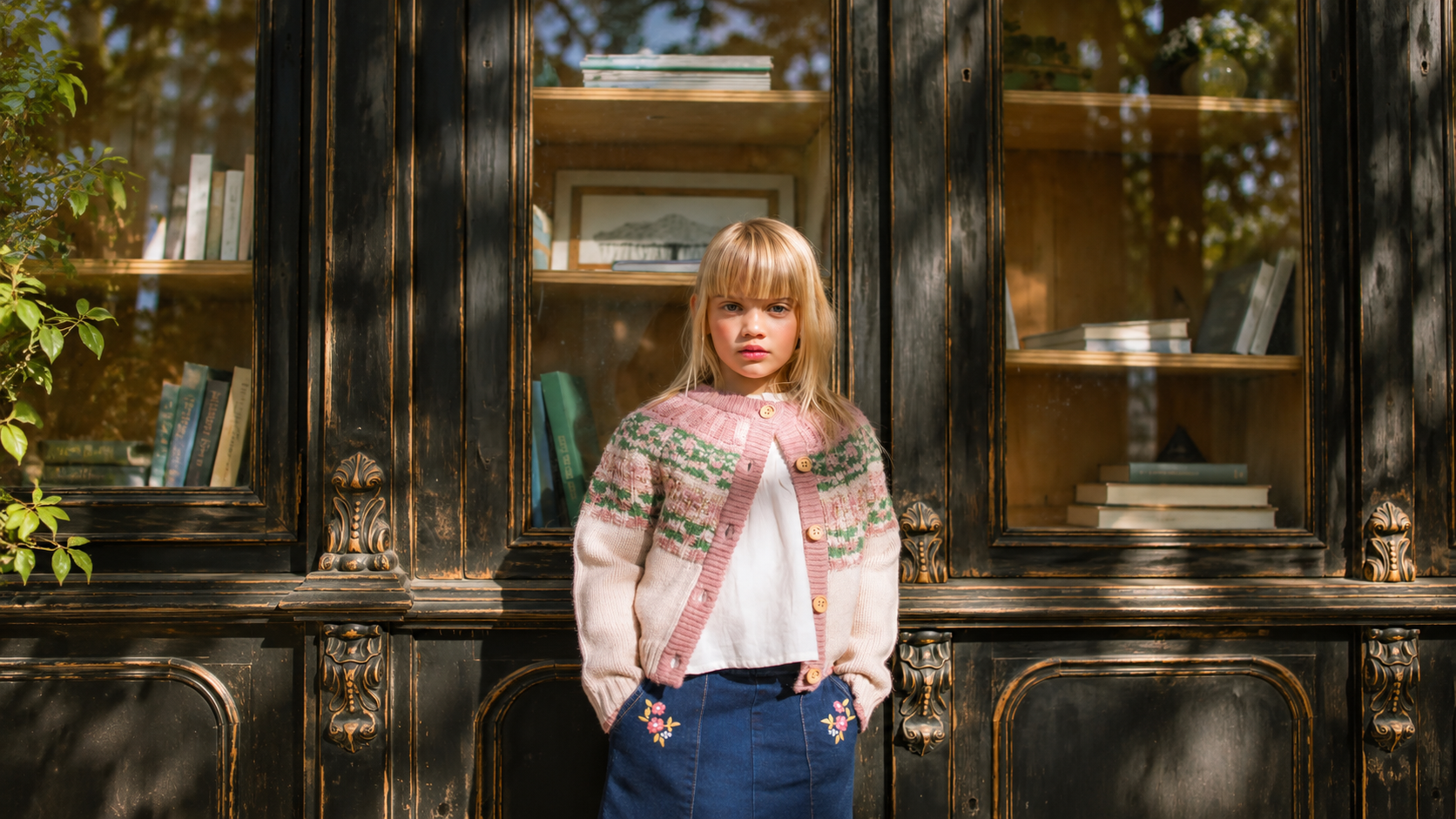
Autumn/winter 2026 kidswear trends are best read as several commercial directions, rather than one look every retailer should buy. January trade-show reporting points towards comfortable sports-inspired dressing and college references, while specialist design commentary highlights tactile surfaces, expressive accents and nature-led graphics. For buyers working with a kidswear OEM manufacturer, the useful question is which ideas can become a coherent, costed collection for their own customers.
Scope: This analysis covers the Northern Hemisphere autumn/winter 2026–27 season. It draws on the sources linked below and separates reported observations from QH Apparel’s purchasing interpretation. These sources are not a global sell-through dataset. As of October 2026, use the analysis to review the current assortment and inform subsequent development; it is not a promise that a new full-season order can still meet a particular delivery date.
1. Comfortable college styling: an everyday proposition
Observed signal: ANSA’s January 21 report from Pitti Bimbo 102 identifies activewear, college styling and comfort in the autumn/winter 2026–27 offer. Its Sarabanda examples include sweatshirt-and-jersey jogger sets, preppy graphics and relaxed silhouettes. This is evidence of an exhibition direction, not proof that every market is moving towards the same fit.
Buyer interpretation: Treat the trend as a styling language that can work across familiar garment types. A sweatshirt, coordinating bottom and layering piece can share an artwork or colour story without requiring every item to be sold together. Decide whether the collection needs a visibly oversized silhouette or simply easier movement; the two require different fit decisions.
For kids clothing sets, visual coordination should survive the approval process. Ask which fabric and rib combinations will be reviewed together and how paired measurements will be assessed. Our guide to shrinkage and fit risks in kids clothing sets explains why approving each piece separately can leave a gap.
2. Texture and crafted detail: selective differentiation
Observed signal: ANSA also reports winter knitwear and embroidered regenerated-cashmere pieces at Pitti Bimbo. Separately, surface-design studio Fatamadrina’s F/W 2026–27 commentary describes textured fabrics and decorative surfaces, including velvet, bouclé, embroidery and appliqué. The latter is a specialist creative viewpoint rather than a quantified market forecast.
Buyer interpretation: A tactile feature can give a familiar shape a distinct identity, but adding several effects to the same garment makes cost comparison harder. Consider one focal detail per proposed style, then ask for a version with and without it. This makes the incremental design cost visible instead of hiding it inside a single finished-garment price.
Review the actual proposed fabric and decoration together. Specify the intended appearance after care, the feel on the reverse of the decoration and the acceptance criteria that the supplier should work to. A soft sample surface alone does not demonstrate durability, and an attractive decorative treatment does not establish suitability for every age group.
3. Grounded palettes with controlled accents
Observed signal: Fatamadrina places natural and neutral colours alongside options such as sage, apricot, spiced red and electric blue. Its print directions include imaginative stories, small-scale nature references and retro florals. These are useful design prompts; they should not be presented as a universal “top-selling colour” list.
Buyer interpretation: Build the palette around combinations customers can actually wear across the range. A proposed approach is to carry a limited base palette through several garments and concentrate a stronger accent in selected graphics or details. This is an assortment method, not a prescribed colour ratio.
Before adding another colourway, map it to the styles and sizes it supports. Check whether it adds a useful outfit combination or merely another small production quantity. Keep physical colour references and approval responsibilities clear, particularly when a single outfit combines different fabric types. A digital moodboard is a direction-setting tool, not the final material standard.
4. Lasting essentials alongside seasonal newness
Observed signal: FashionUnited’s January Playtime report discusses material quality, longevity and circularity through Minimalisma, MarMar Copenhagen and Gray Label. Gray Label’s permanent essentials supplemented by seasonal drops illustrate one way of balancing continuity with novelty. These individual business examples do not prove that a particular material or sustainability claim guarantees demand.
Buyer interpretation: Separate the role of each style before allocating development resources: a repeatable essential, a seasonal colour update or a more experimental design. A successful core shape may need less visual change than a statement piece. Review actual customer response and returns before deciding which elements deserve continuity.
For private label kids clothing, ask what documentation supports any material or environmental claim you intend to make. Define the claim precisely and verify its applicability to the actual product. Do not infer finished-product certification from a general supplier statement or from the presence of one preferred fibre.
Turning autumn/winter trends into a supplier brief
Translate each selected direction into a brief with a defined customer, age range, garment role, reference silhouette, fabric direction and intended retail positioning. Explain which details are essential to the concept and which may change during costing. Keep inspiration references separate from approved technical instructions.
When evaluating a private label kidswear manufacturer, ask the proposal to separate fabric development, artwork or decoration work, sample revisions and size coverage. Compare alternatives on the same scope. A lower quote is not directly comparable if it leaves a major development decision unresolved.
For collection structure, use our private label kidswear capsule planning guide. For a project discussion with QH Apparel, a kidswear OEM and ODM manufacturer in China, bring the selected styles, technical references, quantities and delivery requirements. Material options, feasibility, pricing and timing need confirmation for the specific project.
Editorial conclusion: The strongest use of these autumn/winter 2026–27 childrenswear signals is disciplined selection: comfortable silhouettes, a clear visual story and enough development detail to evaluate the finished product. Trend visibility can justify a test; purchase depth should follow evidence from your own market.
If your team uses AI to summarise trend references or generate collection ideas, read our analysis of AI in kidswear fashion and buying for the distinction between visual exploration, demand evidence and an approved product specification.