
Kidswear quality control is one of the most important parts of managing a reliable children’s clothing supply chain. Children’s garments must meet demanding expectations for safety, comfort, durability, fit, and appearance. A structured inspection process helps brands prevent defects, protect customers, reduce returns, and keep production schedules under control.
This practical checklist explains what apparel brands should review from product development through final shipment when working with a kidswear manufacturer.
1. Confirm Product Requirements Before Sampling
Effective kidswear quality control starts before the first sample is made. A complete tech pack should define measurements, construction, stitching, fabric composition, color standards, trims, labels, artwork placement, packaging, and applicable testing requirements. When specifications are incomplete, factories must make assumptions, increasing the risk of inconsistent samples and bulk production errors.
Brands should identify the intended age group and target market. Requirements for babywear, toddler clothing, and older children’s apparel may differ. Clear product standards allow the manufacturer, merchandiser, pattern team, and quality inspectors to work from the same approved reference.
2. Review Fabric and Material Safety
Fabric selection affects comfort, performance, appearance, and compliance. Before bulk production, confirm fiber composition, fabric weight, width, color, shrinkage, colorfastness, pilling performance, and hand feel. For products worn directly against the skin, softness and breathability deserve particular attention.
Children’s clothing materials may require chemical and physical testing based on the destination market. Brands should discuss restricted substances, flammability rules, small-parts risks, drawstring requirements, and other relevant standards with their supplier and testing partner. Test reports should match the actual bulk fabric and trims.
3. Approve Fit and Measurements
A good-looking garment can still fail if the fit is inconsistent. Review sample measurements against the approved specification and record every revision clearly. Key points may include body length, chest width, sleeve length, neck opening, waist, hip, rise, and leg opening.
Fit samples should be checked on an appropriate mannequin or fit model when possible. After approval, the final measurement chart and grading rules should be locked for production. During bulk manufacturing, inspectors should measure garments across multiple sizes and production lots.
4. Inspect Construction and Workmanship
Construction quality determines how well a garment performs during wear and washing. Inspect seam type, stitch density, seam allowance, reinforcement, topstitching, hemming, and attachment strength. High-stress areas such as crotch seams, armholes, pockets, waistbands, and closures may require extra reinforcement.
Quality inspectors should look for skipped stitches, broken threads, open seams, puckering, twisting, needle damage, uneven hems, raw edges, and loose components. Workmanship standards should be demonstrated with an approved pre-production sample.
5. Check Trims, Fasteners, and Small Parts
Buttons, snaps, zippers, elastic, cords, patches, and decorative components must suit the garment and age group. Confirm color, size, finish, placement, function, and attachment security. For babywear and young children’s products, loose small parts can create serious safety risks.
Pull tests or other attachment-strength checks may be required. Sharp points, rough edges, broken zipper teeth, exposed metal, and poorly finished components should never pass inspection. Spare trims used in production should be traceable to the approved specification.
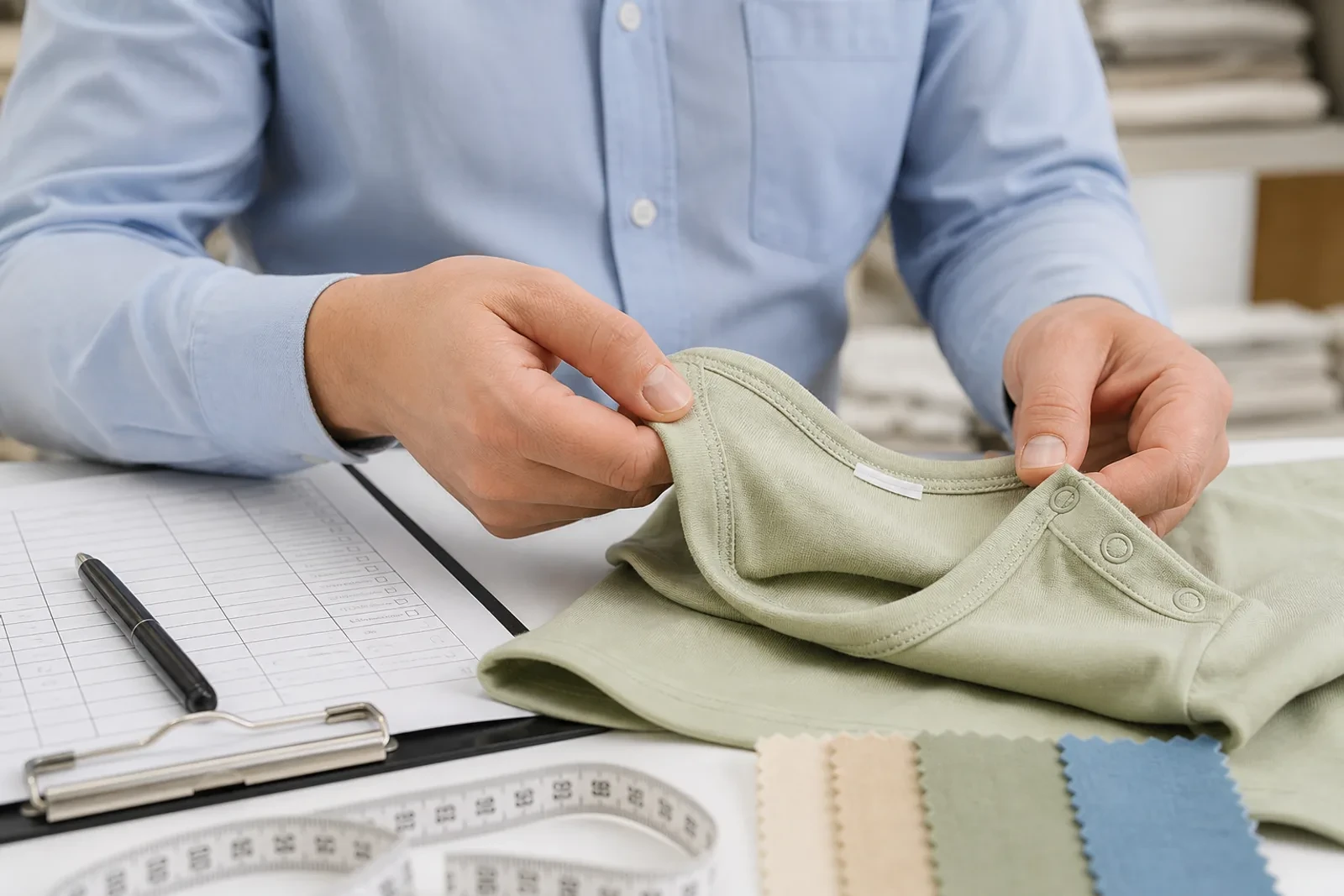
6. Control Color and Appearance
Color variation is a common source of buyer complaints. Bulk fabric, rib, thread, lining, prints, and trims should be compared under consistent lighting against the approved color standard. Different dye lots must be identified and controlled to avoid visible shade differences within one garment or shipment.
Printed and embroidered artwork should be checked for position, dimensions, color, registration, coverage, and durability. Inspectors should also review garment symmetry, pattern matching, fabric direction, pressing, cleanliness, and overall presentation.
7. Verify Labels and Packaging
Incorrect labeling can delay a shipment even when garment quality is acceptable. Confirm brand labels, size labels, care labels, fiber content, country of origin, warning labels, hangtags, barcode information, and carton marks against approved files and destination-market requirements.
Packaging should protect garments without creating unnecessary damage or moisture risk. Check folding method, polybag size, suffocation warnings where required, assortment ratio, carton quantity, carton strength, and shipping marks. A packing audit should compare physical goods with the purchase order.
8. Use In-Line and Final Inspections
Waiting until production is complete makes corrections slower and more expensive. In-line inspection allows the manufacturer to identify recurring defects while garments are still being sewn. Early findings can be communicated to the line supervisor and corrected before affecting the full order.
A final random inspection should take place when production and packing are substantially complete. It should cover workmanship, measurements, function, appearance, labeling, packaging, quantity, and buyer-specific requirements. Brands may use an agreed AQL standard, but acceptance criteria should be confirmed before inspection.
9. Document Corrective Actions
Inspection reports should clearly show what was checked, what failed, and what must happen next. Include defect photos, quantities, severity, affected sizes or colors, and corrective-action responsibility. Reinspection may be necessary when major issues are discovered.
The best quality systems do more than reject individual garments. They identify root causes and prevent recurrence. Repeated defects may point to unclear specifications, unstable materials, inadequate operator training, unsuitable machinery, or weak production controls.
10. Evaluate the Manufacturer’s Quality System
A dependable kidswear manufacturer should explain its quality-control workflow from incoming material inspection through final packing. Ask who approves samples, who controls production standards, how inspection findings are recorded, and how problems are escalated.
Strong suppliers communicate risks early, maintain traceable approvals, and treat quality as a shared production responsibility. They do not rely only on final inspection to discover preventable issues.
Build a Reliable Kidswear Production Process
Consistent kidswear quality control protects both customers and brands. The best results come from clear specifications, approved materials, disciplined sampling, in-line monitoring, final inspection, and transparent corrective action.
QH Apparel supports OEM and ODM kidswear manufacturing from product development and sampling through bulk production and quality control. If your brand is looking for a children’s clothing manufacturer with structured communication and production follow-up, contact our team to discuss your requirements.